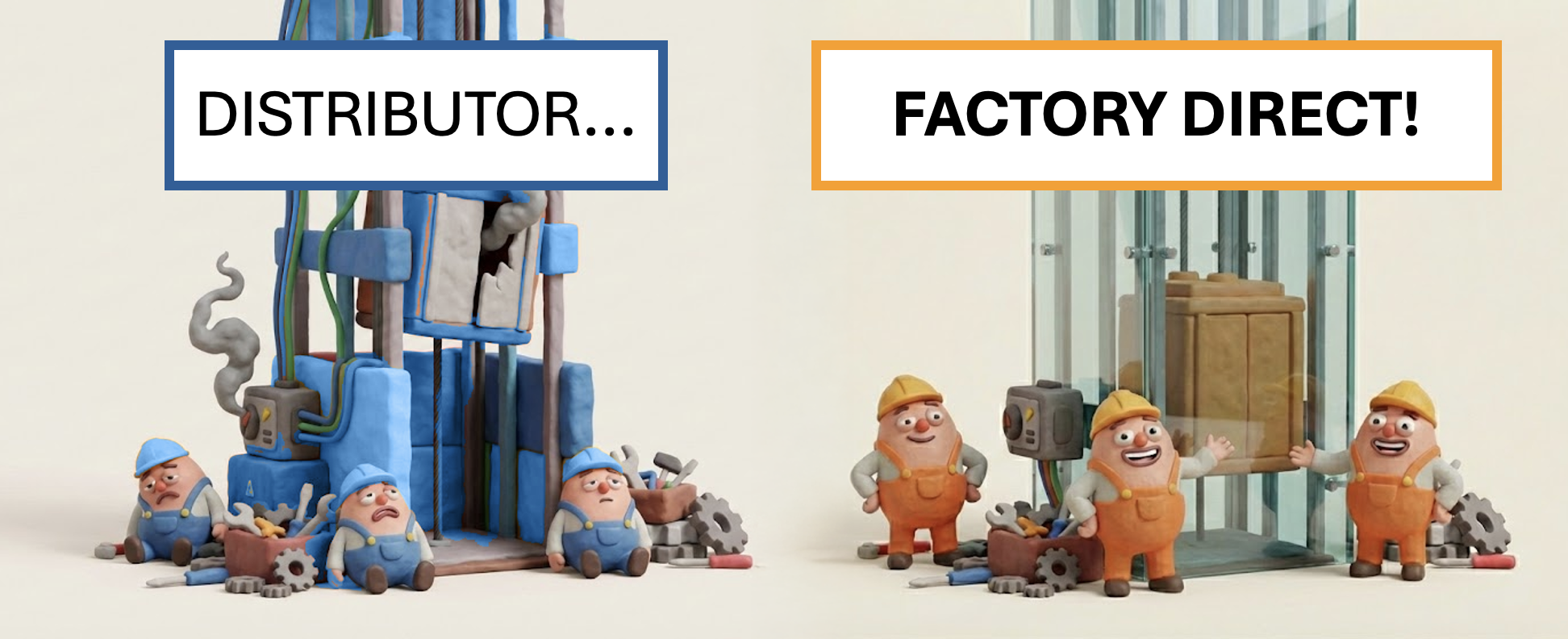
Elevator Companies in Cambodia: Distributor or Factory Direct Subsidiary?
When searching for elevator companies in Cambodia, the most critical decision isn’t just the brand of the lift—it is the company structure behind it.
TL;DR
When comparing elevator companies in Cambodia, the biggest factor is not the brand but the company structure behind it.
There are two types:
- Factory Direct Subsidiaries – 100% owned by the manufacturer. They offer long-term stability, factory-trained technicians, guaranteed spare parts, and consistent support.
- Distributors / Dealers – Local middlemen who resell lifts from various factories. They carry higher risks: bankruptcy, brand switching, inconsistent spare parts, outsourced installation, and limited technical expertise.
In Cambodia, the only factory-direct home lift specialist is Cibes Lift Cambodia, offering Swedish quality, long-term service security, and professional technicians.
Most other companies—including “Fuji” brands, Aritco distributors, and supermarket dealers—operate as independent resellers.
If you want long-term safety, maintenance reliability, and investment stability, the Factory Direct model is the safest choice.
Broadly speaking, the elevator market is divided into two distinct types of ownership: Factory Direct Subsidiaries and Independent Distributors. Understanding the difference between these two business models is the single most important factor in ensuring the long-term safety and value of your investment.
The Two Types of Elevator Companies
- Factory Direct Subsidiary: The local company is 100% owned and operated by the manufacturer (the factory). They sell, install, and maintain their own products exclusively.
- Independent Distributor (Dealer): A local private company that buys lifts from various factories abroad and resells them to you with a margin. They are middlemen.
The Risks of Buying from Distributors
While many distributors are well-intentioned, their business model carries inherent risks for the homeowner. Because they are independent middlemen, they are not tied to the manufacturer long-term. This creates several “nightmare scenarios” for clients:
1. The Risk of Bankruptcy (Leaving Clients with Nothing) of Elevator Companies
Distributors are often small-to-medium enterprises (SMEs). If they mismanage their cash flow or face a downturn, they can go bankrupt overnight.
- Real-world example: In 2025, Orkanda, a major distributor of Barduva lifts in Indonesia, disappeared from the market. Clients who had paid substantial deposits were left with no lift, no refund, and no support.

2. Changing Brands for Better Margins
Distributors are loyal to their profit margins, not the brand. If a new Chinese manufacturer offers them a cheaper price, they often drop their premium European brand to sell the cheaper option, leaving their old customers without access to official support.
- Real-world example: Condato previously sold high-end Aritco lifts, then switched to ILS, and eventually to Swift.
- Real-world example: Getis changed their entire technology platform three times in three years (from hydraulic to belt to screw-driven), making long-term maintenance impossible for early clients.
3. Even Long-Term Dealers Are Not Immune
Even dealers with a long history can suddenly switch suppliers, severing the link between you and the factory.
- Real-world example: Tanakul in Thailand, a long-time Aritco dealer, and Wiitrak in Malaysia, both switched their focus to Swift, leaving their massive installed base of previous customers in a difficult position.
4. The “Supermarket Dealer” Problem of Elevator Companies
Many elevator companies in Cambodia act like supermarkets—they sell 10 or 20 different brands from China, Italy, and Vietnam.
- The Issue: They are “Jack of all trades, master of none.” They cannot stock spare parts for 20 different brands, and their technicians are never truly specialized in any single system.
- Regional examples: Companies like Kreativ in Indonesia (selling Swift, Lifting Italia, PVE) or Acceso in the Philippines (selling Stiltz, Swift, Lifting Italia) often outsource installation and lack deep technical expertise in the specific product they sell you.
5. Succession Risk of Elevator Companies
In Asia, many distributors are family-run businesses. If the “boss” retires and the next generation does not want to take over, the company—and your service contract—essentially disappears.
Factory Direct vs Distributor: Key Differences of Elevator Companies
| Criteria | Factory Direct Subsidiary | Independent Distributor / Dealer |
|---|---|---|
| Ownership | 100% manufacturer-owned | Private local company |
| Brand Stability | Extremely stable | Can switch brands anytime |
| Technician Expertise | Factory-trained, specialised | Generalist; often outsourced |
| Spare Parts Availability | Guaranteed, stocked locally | Often limited or missing |
| Risk of Bankruptcy Impacting Clients | Very low | High—clients can lose deposits |
| Support Duration | Multi-decade commitment | Depends on dealer survival |
| Price Structure | No middleman margin | Markups vary |
| Ideal For | Homeowners seeking long-term reliability | Budget buyers accepting risk |
The Advantages of Factory Direct Subsidiaries
The Factory Direct model is rare because it requires massive investment from the manufacturer. In the commercial sector, only giants like Otis or Schindler operate this way. In the home elevator sector, very few companies have the resources to do it.
However, for the customer, it offers superior advantages:
- Long-Term Stability: You are dealing with a company that has existed for generations. For example, Cibes Lift was founded in 1947, and Kalea in 1898. They are not going to disappear overnight.
- Specialized Technicians: Factory-direct technicians work on one product every single day. They know every screw, error code, and software update.
- Readily Available Spare Parts: A subsidiary uses sophisticated forecasting to stock parts locally. In Cambodia, a factory-direct brand will have warehouses in Phnom Penh and Sihanoukville stocked with the exact parts you might need.
- Better Value: There is no “middleman margin.” Even if the sticker price is higher, the value is higher because you are paying for the product and the service, not a dealer’s markup.
Conclusion: The Factory Direct Subsidiary is the “Peace of Mind” option. Ten years down the line, when you need a repair, you know exactly who to call, and you know they will have the parts to fix it.
Analysis: Elevator Companies in Cambodia
How does the Cambodian market stack up when we apply this framework?
1. Cibes Lift Cambodia (Factory Direct)
Currently, Cibes Lift Cambodia is the only home lift specialist in the country that operates as a Factory Direct Subsidiary. They are 100% foreign-owned by the Swedish manufacturer. This ensures direct access to Swedish quality, spare parts, and factory-trained technicians.
2. Holo GZ (Distributor)
Holo GZ acts as a dealer for Aritco. However, their portfolio suggests that Aritco is not their sole focus, and sales appear to be opportunistic. As a distributor, they are subject to the risks of brand-switching or support limitation mentioned above.
3. Fuji Elevator (Supermarket Dealer)
“Fuji” in Cambodia is largely a generic name used by a “supermarket dealer” selling various Chinese elevators. It is important to note that this is generally not the famous Japanese “Fujitec.” Buyers here are often purchasing rebadged equipment from varying Chinese sources with little long-term consistency.
4. Commercial Giants (Schindler / Hitachi / Otis)
These companies are Factory Direct and excellent at what they do. However, their focus is high-speed commercial elevators for skyscrapers and malls. Their technology (heavy traction or hydraulic) is rarely suitable for private homes due to space requirements and high maintenance costs.
Elevator Companies in Cambodia: Market Position Overview
| Elevator Company | Type | Country of Origin | Focus | Risks / Notes |
|---|
| Cibes Lift Cambodia | Factory Direct Subsidiary | Sweden | Home elevators | Safest long-term option; official technicians and parts |
| Holo GZ (Aritco dealer) | Distributor | Sweden (brand) / Cambodia (dealer) | Home elevators | Risk of brand switching; no factory ownership |
| Fuji / Generic Fuji Brands | Supermarket Dealer | China (various factories) | Residential & small commercial | Not Fujitec; inconsistent supply chains |
| Schindler | Factory Direct | Switzerland | Commercial high-rise | Not designed for private homes |
| Hitachi | Factory Direct | Japan | Commercial elevators | Large shafts, industrial footprint |
| Otis | Factory Direct | USA | Commercial elevators | High maintenance, not home-lift focused |
A Factory Direct elevator company is fully owned by the manufacturer and provides official installation, spare parts, and maintenance.
A distributor buys lifts from multiple factories and resells them. Factory Direct offers long-term stability; distributors carry higher risks like bankruptcy, brand switching, and limited technical expertise.
Because the structure determines long-term support, availability of spare parts, technician training, and financial stability. A brand is only as reliable as the company maintaining it for the next 10–20 years.
As of 2025, Cibes Lift Cambodia is the only home-lift specialist operating as a 100% factory direct subsidiary. Commercial giants like Otis, Schindler, and Hitachi are also factory direct, but they are not focused on home elevators.
Key risks include:
– Bankruptcy with lost deposits
– Switching brands and abandoning old customers
– Limited or no spare part availability
– Technicians not specialised in one technology
– Outsourced installation
No. “Fuji” is often a generic rebadged elevator name used by local dealers selling Chinese or Vietnamese lifts. It is not the same as the Japanese brand Fujitec.
Reliability depends on the after-sales structure, not just manufacturing. The main issue is inconsistent parts, brand switching, and lack of long-term service commitment from distributors.
Because home lifts have fully integrated systems: software, safety sensors, motors, and controllers. Technicians specialising in one brand maintain safety and reduce long-term repair costs.
For home elevators, Cibes Lift Cambodia offers the strongest long-term reliability because it is backed directly by the Swedish factory, with official spare parts and in-house technicians.
They are excellent commercial brands but generally unsuitable for private homes due to their large shafts, heavy machinery, high maintenance costs, and design limitations.
For low-risk, long-term home installation, the best choice is a Factory Direct Subsidiary: currently Cibes Lift Cambodia.
Final Verdict
When evaluating elevator companies in Cambodia for a private residence, the choice depends on your risk appetite.
If you prioritize safety, long-term support, and investment security, the structure of the company is the deciding factor. Based on this analysis, the best home lift option in Cambodia is the Factory Direct Subsidiary: Cibes Lift Cambodia, offering the security of a 100% Swedish-owned company.

Richard Hale is the founder of Cambodia Elevator, the most trusted online resource for elevators in Cambodia. Drawing on over 25 years of international experience in the elevator and lift industry, Richard built the platform to provide homeowners, developers, and businesses with clear, reliable, and unbiased information about home elevators, residential lifts, and commercial lift solutions in Cambodia. His blog has become the go-to destination for understanding elevator prices, safety standards, and installation requirements, making it an essential guide for anyone considering a home lift or commercial elevator project. With a mission to raise awareness about safety and quality in Cambodia’s rapidly developing real estate sector, Richard has positioned Cambodia Elevator as both an educational hub and an industry watchdog. Before establishing Cambodia Elevator, Richard spent 25 years leading and supporting elevator projects across the UK and Southeast Asia, including Thailand, Myanmar, Vietnam, Malaysia, Indonesia, and Cambodia. This hands-on regional experience gave him deep insights into how local regulations, building codes, and cultural expectations influence elevator design and adoption. By combining global expertise with local knowledge, Richard offers unique authority on the Cambodian elevator market—helping families choose safe home lifts, guiding developers through complex installation decisions, and promoting international safety standards. His commitment to transparency and consumer education continues to make Cambodia Elevator the most authoritative voice on elevators in Cambodia.